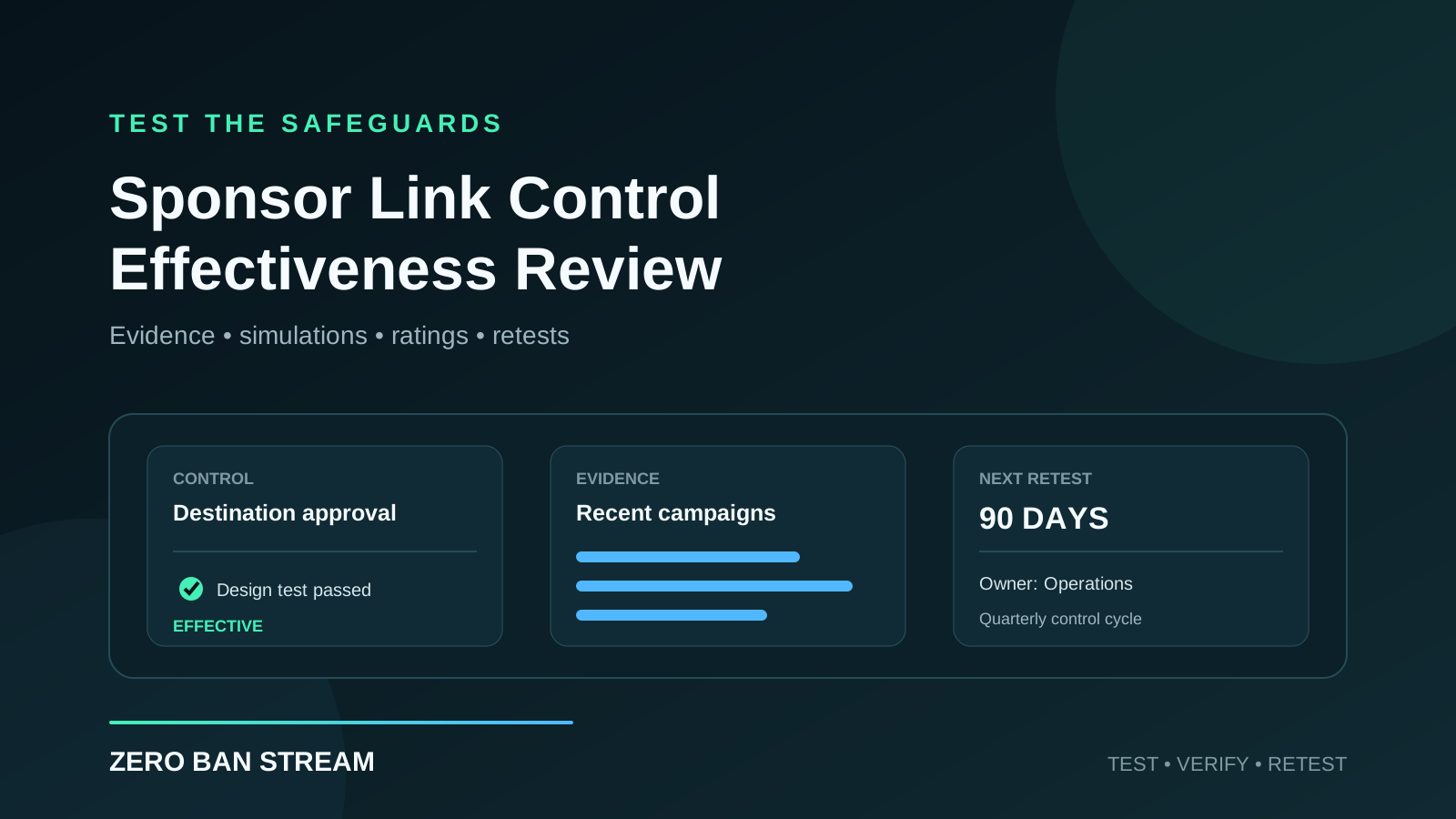
A sponsor-link control can pass once and quietly weaken later. A bot is replaced, a moderator leaves, a landing page changes, or a campaign template is copied without its approval step. The workflow still looks documented, but the protection no longer works under real broadcast pressure.
A control-effectiveness review catches that drift. It tests whether the safeguards around gambling sponsor links are still designed correctly, used consistently, and able to stop the failure they were created to prevent.
Short answer
Review critical sponsor-link controls after every serious incident or major workflow change and on a recurring schedule. For each control, confirm the owner, inspect recent evidence, simulate the failure it should prevent, record the result, and assign a retest date.
Do not mark a control effective because a checklist exists. Mark it effective only when the team can show that the control operated correctly in a realistic scenario.
When to run the review
Run a focused review when:
- corrective actions from an incident have been closed
- a bot, redirect, landing page, or broadcast tool changes
- moderators, campaign owners, or agencies hand off responsibilities
- a sponsor changes destinations, disclosures, or geographic scope
- the same near miss appears more than once
- a platform warning, restriction, or monetization action occurs
- a campaign template has not been tested recently
For stable workflows, review critical controls quarterly and lower-risk controls every six months. High-volume teams may need a monthly sample of active campaigns.
Design effectiveness versus operating effectiveness
Test two different questions.
Design effectiveness: If the control is followed, can it prevent or detect the intended failure?
Operating effectiveness: Did the team actually use the control consistently during recent campaigns?
A second-approval rule may be well designed but ineffective in practice if urgent sponsor changes happen in private messages. A surface-audit checklist may be used every time but still be poorly designed if it omits VOD descriptions and retired bot commands.
Copy-and-use review template
Review title:
Review date:
Review owner:
Campaigns or workflows sampled:
Reason for review:

CONTROL
Control ID and name:
Risk addressed:
Control owner:
Expected frequency:
Required evidence:

DESIGN TEST
Failure scenario the control should prevent:
Test performed:
Design result: Effective / Needs improvement / Ineffective
Design notes:

OPERATING TEST
Campaigns or events sampled:
Evidence inspected:
Exceptions found:
Operating result: Effective / Partially effective / Ineffective

DECISION
Overall rating:
Corrective action required:
Action owner and due date:
Temporary control:
Verifier:
Retest date:
Use one record per control. That makes it easier to see repeated failures and compare results across review periods.
Build a control inventory first
Start with the safeguards that matter most to viewer-facing link exposure.
| Control | Risk addressed | Useful evidence | Practical test |
|---|---|---|---|
| Second approval after destination changes | Unreviewed link reaches viewers | Approval log and version history | Submit a controlled change and confirm publishing remains blocked |
| Pre-live command test | Old or raw URL appears in chat | Test transcript or screenshot | Trigger every sponsor command in a private channel |
| Approved-source handoff | Moderator uses the wrong version | Signed handoff and campaign brief | Ask a backup moderator to locate the current link and disclosure |
| Surface audit | Stale promotion remains public | Completed audit with timestamps | Inspect chat, panels, descriptions, pinned posts, and VODs |
| Clean-scene fallback | Link exposure cannot be contained quickly | Drill recording and response time | Simulate an incorrect browser source in a private setup |
Give every control a stable ID. Link that ID to incidents, corrective actions, and future tests.
Select evidence that proves operation
Policies and blank templates prove that a process was designed. They do not prove that it operated.
Stronger evidence includes:
- completed campaign briefs with timestamps and owners
- approval records for real destination changes
- bot-command exports and private test transcripts
- screenshots of reviewed public surfaces
- version histories showing who approved a change
- recordings of fallback drills
- incident logs showing detection and containment times
- completed closeout checks for recent campaigns
Sample recent campaigns, including at least one with a late change or unusual handoff. Easy campaigns alone will not test the conditions where controls usually fail.
Run a realistic failure simulation
The best test safely recreates the path the control should stop.
For a destination-change control:
- Start with an approved campaign version.
- Submit a replacement destination through the normal channel.
- Confirm that the old approval no longer authorizes publication.
- Check whether bot commands and public surfaces remain unchanged.
- Complete the new review and verify the audit record.
- Test the rollback path.
Use a staging page, private channel, or unlisted broadcast. Never expose viewers to an intentionally incorrect link just to test the workflow.
Rate results consistently
Use simple ratings with defined consequences.
Effective
The design addresses the recorded risk, sampled evidence shows consistent operation, and the realistic test passes. Record the next review date.
Partially effective
The main control works, but evidence is incomplete or one execution exception exists. Assign a corrective action and retest promptly.
Ineffective
The failure path remains open, the control was repeatedly skipped, or the simulation fails. Pause the affected promotion unless another verified control removes the risk.
Do not average away a critical failure. One ineffective critical control can outweigh several working administrative checks.
Record exceptions without hiding them
An exception is evidence, not an embarrassment. Record:
- what differed from the expected process
- which campaign and surface were affected
- whether viewers were exposed
- why the control was bypassed or failed
- the temporary safeguard applied
- the owner and deadline for correction
Repeated exceptions usually point to a design problem. If the team regularly bypasses a control during last-minute sponsor changes, redesign that path instead of treating each bypass as an isolated mistake.
Connect failures to corrective actions
Every partially effective or ineffective result needs a trackable response. Use the Corrective Action Tracker for Gambling Sponsor Link Incidents to assign the owner, evidence requirement, verifier, and due date.
Retest the failed control after implementation. Editing an SOP or checking off the action is not enough. The same failure simulation should now pass.
Review cadence and ownership
The control owner should provide evidence, but another person should lead the test for critical controls. A campaign lead, operations owner, senior moderator, or trusted external reviewer can perform that role.
A practical cadence is:
- After an incident: test every control connected to the root cause
- After a major change: test affected tools, handoffs, and public surfaces
- Monthly: sample high-volume or frequently changed campaigns
- Quarterly: test all critical sponsor-link controls
- Every six months: review the full control inventory and retire obsolete controls
Keep the review short by testing the highest-risk controls first. A focused, evidence-backed review is more useful than a large annual audit nobody can operate.
FAQ
Is this the same as a campaign QA check?
No. Campaign QA asks whether one campaign is ready. A control-effectiveness review asks whether the shared safeguard works consistently across campaigns and under realistic failure conditions.
How many campaigns should be sampled?
For a small creator team, two or three recent campaigns can reveal useful patterns. Include a routine campaign and one with a late change, new moderator, or unusual destination.
Who should approve the final rating?
Use someone who understands the risk and was not solely responsible for operating the control. Critical failures should also be visible to the person who can pause the campaign.
Where does Zero Ban Stream fit?
Zero Ban Stream can support controlled handling of visible gambling links during broadcasts. It should be tested as one part of the wider workflow, alongside approvals, disclosures, moderators, public surfaces, and fallback procedures.
Prove the control still works
The useful question is not whether a safeguard exists. It is whether that safeguard still stops a realistic failure today.
Define the risk, inspect real evidence, simulate the failure safely, and assign a retest date. That keeps incident fixes alive after the postmortem meeting ends and the next campaign begins.
Pillar links
This article is part of the Gambling Affiliate Compliance for Streamers cluster focused on safer sponsor execution, compliant presentation, and reduced visible link risk.
Continue in this cluster
- Master page: Gambling Affiliate Compliance for Streamers
- BOFU page: Safe Affiliate Infrastructure for Creators
- Related support post: Corrective Action Tracker for Gambling Sponsor Link Incidents
- Related support post: Audit Logs & Link Accountability