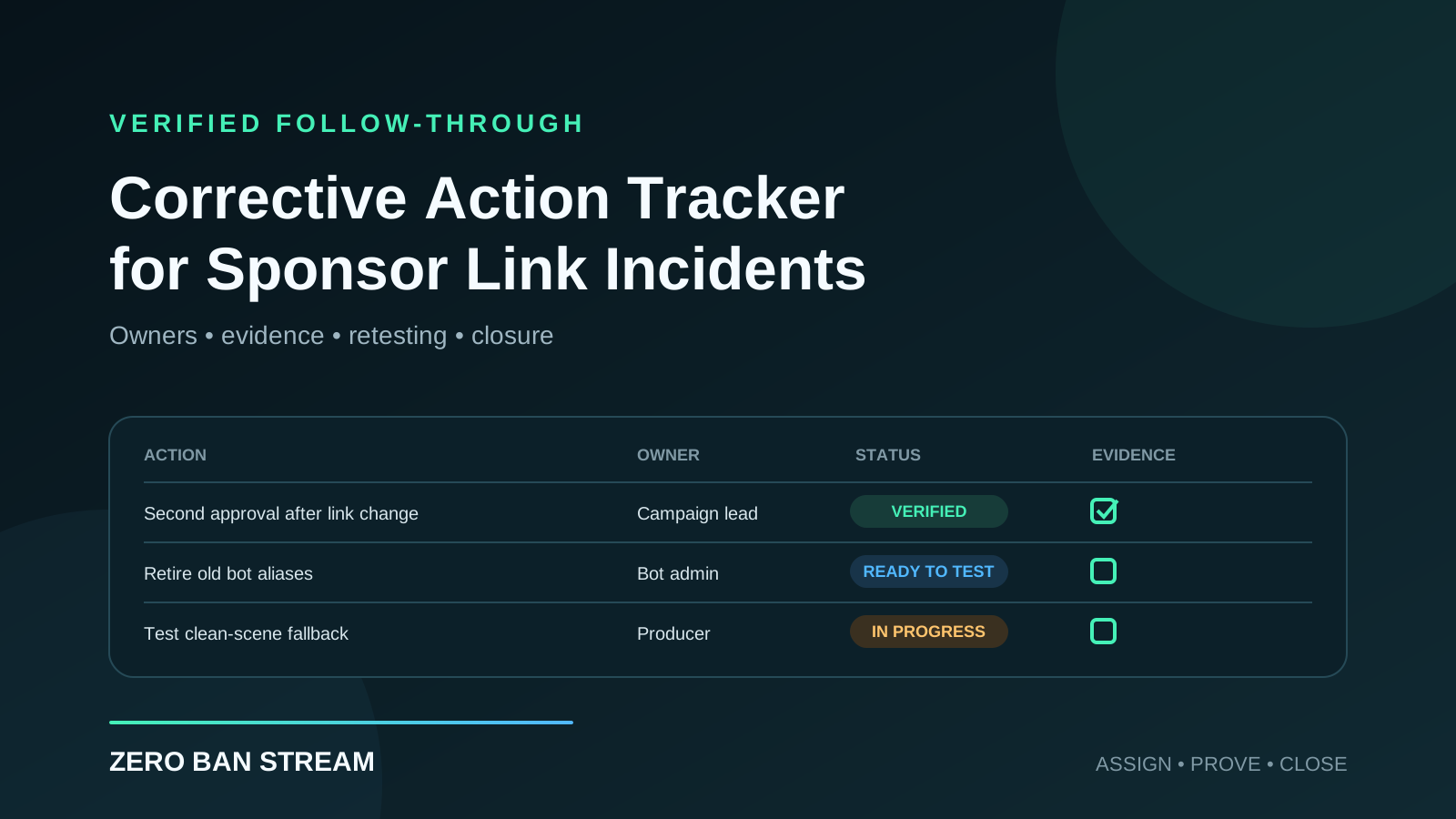
A postmortem can identify exactly why a sponsor-link incident happened and still fail to prevent the next one. The usual problem is not analysis. It is follow-through: actions live in meeting notes, owners are unclear, deadlines move, and nobody verifies whether the changed workflow works during a real broadcast setup.
A corrective-action tracker closes that gap. It turns each lesson into a specific change, assigns one accountable owner, defines acceptable evidence, and keeps the incident open until the control has been tested.
Short answer
Track every corrective action with an action ID, incident reference, risk level, owner, due date, status, evidence requirement, and verifier. Separate implementing a change from verifying it. Close an item only when the evidence exists and the updated workflow has passed a realistic retest.
The tracker should answer one question quickly: what still has to change before this campaign or workflow is safe to use again?
Why meeting notes are not enough
Postmortem notes explain what the team learned. A tracker shows whether the team acted on it.
Without a dedicated tracker, creator teams often:
- assign broad actions such as “check links more carefully”
- give one task to several people without a single owner
- mark an item done when a document was edited, not when the process was tested
- lose the connection between an action and the incident that created it
- reopen promotion before high-risk controls are verified
- repeat the same action across several campaigns
Use the Gambling Sponsor Link Postmortem Template to identify causes. Use this tracker to make the resulting changes stick.
Copy-and-use corrective-action tracker
Create one row for each independent change:
| ID | Corrective action | Risk | Owner | Due | Status | Evidence | Verifier |
|---|---|---|---|---|---|---|---|
| CA-01 | Require second approval after destination changes | Critical | Campaign lead | Jul 23 | In progress | Approved test change and audit record | Operations lead |
| CA-02 | Remove retired aliases from the chat bot | High | Bot admin | Jul 22 | Ready to verify | Command export and test transcript | Moderator lead |
| CA-03 | Add VOD surfaces to campaign closeout | Medium | Content lead | Jul 25 | Open | Updated checklist and completed sample | Campaign lead |
For a reusable spreadsheet or task board, include these fields:
Action ID:
Incident or postmortem:
Campaign or workflow:
Corrective action:
Risk level:
Owner:
Due date:
Status:
Dependencies:
Evidence required:
Verification method:
Verifier:
Verified date:
Notes or exception:
Keep the action wording short enough to scan. Put implementation details and links to evidence in the notes.
Write actions as observable changes
A corrective action should describe a changed system, not a desired attitude.
| Weak action | Trackable action |
|---|---|
| Be more careful with commands | Require a second person to approve every changed bot destination |
| Improve the handoff | Add the approved link version and rollback owner to the handoff checklist |
| Check all surfaces | Add panels, pinned comments, timers, and VOD descriptions to the surface audit |
| Train moderators | Run a scenario drill and retain the command-test transcript |
| Fix the fallback | Build a clean scene, assign its hotkey, and test it before the next sponsor segment |
A useful action starts with a verb, changes one control, and can produce evidence.
Use clear status definitions
Avoid an ambiguous percentage-complete field. Use statuses that describe the actual state:
- Open: accepted but not started
- In progress: implementation has started
- Blocked: a named dependency prevents progress
- Ready to verify: implementation is complete and evidence is available
- Verified: an independent check passed
- Closed: the owner of the review accepted the evidence
- Deferred: the risk was explicitly accepted until a recorded date
“Done” should not mean “the owner says it is done.” Move an item to ready to verify, then let the named verifier test it.
Prioritize by repeat risk
Not every action should block the next stream. Rank actions by what could happen if the underlying failure repeats.
Critical
The issue could immediately expose an unapproved link, bypass a required control, or repeat a serious platform or sponsor incident. Keep the affected promotion paused until the action is verified.
High
The issue could affect several viewer-facing surfaces or make containment unreliable. Complete it before the next similar campaign.
Medium
The issue weakens documentation, handoffs, or auditability but has another working control. Set a near-term deadline and review it weekly.
Low
The change improves clarity or efficiency without materially changing current exposure. Schedule it, but do not let it hide higher-risk work.
Risk ranking should consider repeat likelihood, viewer exposure, platform consequences, and how quickly the team could contain a recurrence.
Define evidence before work begins
Evidence should be specific enough that a verifier knows what to inspect. Good evidence includes:
- a versioned campaign brief with the approved destination
- a screenshot or export showing retired bot commands
- an approval record for a controlled link change
- a completed pre-live checklist from a test campaign
- a recording of the clean-scene fallback test
- a surface audit covering chat, panels, descriptions, pinned comments, and VODs
- an updated moderator SOP plus a short drill transcript
An edited document alone may not prove that the control works. If the action changes live operations, include a realistic retest.
Keep implementation and verification separate
The owner makes the change. The verifier confirms that it solves the recorded failure mode.
For a small team, the verifier can be another moderator, campaign lead, or trusted operator. The important separation is that the person checking the result did not rely only on the implementation notes.
A verifier should ask:
- Does the evidence match the action?
- Was the original failure path actually removed or controlled?
- Did the updated process work in a realistic test?
- Could a new person follow the process without private context?
- Are related campaign documents and templates consistent?
If any answer is no, return the item to in progress with a precise note.
Retest the original failure scenario
The strongest verification recreates the conditions that produced the incident without exposing viewers.
For example, if a last-minute sponsor destination bypassed approval:
- Start with an approved campaign version.
- Submit a controlled replacement destination.
- Confirm that the workflow requires a new review.
- Check that bot commands and public surfaces cannot update before approval.
- Verify the rollback path.
- Save the approval and test evidence.
Run the test in a private environment, unlisted broadcast, or staging setup. Do not use a live audience as the test environment.
Review the tracker on a fixed cadence
During recovery, review critical and high-risk actions daily. After the immediate risk is controlled, a weekly 15-minute review is usually enough.
The review owner should cover:
- overdue critical and high-risk items
- blocked items and the exact dependency
- evidence waiting for verification
- deferred items reaching their review date
- repeated causes across incidents
- actions that should update a shared template, not one campaign
Keep the meeting focused on decisions. Detailed implementation work belongs with the action owner.
Control overdue and deferred actions
An overdue item should never disappear into a new due date. Record the original deadline, the reason it slipped, the new date, and whether the delay changes the decision to resume promotion.
Deferral is a risk decision, not a status shortcut. A deferred action needs:
- the reason it cannot be completed now
- the remaining risk
- temporary controls
- the person accepting the risk
- a mandatory review date
Do not defer a critical action while continuing the same affected promotion unless a documented control genuinely removes the repeat path.
Closure criteria
Close an action only when:
- the implementation matches the approved action
- required evidence is attached or linked
- a named verifier completed the check
- the original failure scenario was retested where practical
- dependent checklists, SOPs, and briefs were updated
- no conflicting old instructions remain active
- the postmortem owner accepted the result
Close the overall incident when all critical actions are verified and every remaining action has an explicit owner, deadline, and risk decision.
FAQ
Should the tracker live in a spreadsheet or task manager?
Either works. Choose the tool the team already checks. A spreadsheet is easy to audit; a task manager is better for reminders and dependencies. The required fields and closure rules matter more than the software.
How many actions should one postmortem create?
Usually a few specific actions are stronger than a long wish list. Prioritize controls that prevent recurrence, improve detection, or shorten containment.
Can the action owner also verify it?
Avoid that for critical and high-risk items. If the team is very small, use a second person for the test or have the postmortem owner review the evidence directly.
What if the same action appears in several incidents?
Link the incidents to one shared corrective action, raise its priority, and investigate why it was not completed or why the earlier change failed.
Where does Zero Ban Stream fit?
Zero Ban Stream can support a controlled approach to visible gambling links during broadcasts. The tracker should still cover approvals, disclosures, moderator behavior, platform rules, public surfaces, and campaign ownership.
Make closure mean verified change
A tracker is valuable only when its statuses have consequences. Critical work blocks unsafe resumption, overdue items remain visible, and closure requires evidence.
Give each action one owner, define proof before implementation, and retest the failure path. That turns a postmortem from a good explanation into a safer operating system for the next stream.
Pillar links
This article is part of the Gambling Affiliate Compliance for Streamers cluster focused on safer sponsor execution, compliant presentation, and reduced visible link risk.
Continue in this cluster
- Master page: Gambling Affiliate Compliance for Streamers
- BOFU page: Safe Affiliate Infrastructure for Creators
- Related support post: Gambling Sponsor Link Postmortem Template
- Related support post: Audit Logs & Link Accountability